Key EU Regulatory Changes in 2025: Implications for Public Affairs and Compliance Managers
The European Union is introducing several key regulatory changes in 2025, impacting compliance strategies and policy engagement across multiple industries. Public Affairs and Compliance Managers must monitor these developments closely, as they will influence corporate reporting obligations, supply chain responsibilities, environmental compliance, and workforce policies. Understanding the implications of these regulations is essential for anticipating risks and ensuring organizational preparedness.
Corporate Sustainability Reporting and Due Diligence
The Corporate Sustainability Reporting Directive, adopted in 2023, requires large and publicly traded companies to disclose detailed reports on social and environmental risks affecting their operations. EU member states were required to transpose this directive into national law by July 6, 2024. However, as of early 2025, some member states have yet to complete this process, potentially leading to rapid legislative adjustments. Companies operating across multiple jurisdictions must remain alert to national variations in implementation and potential shifts in reporting requirements.
The Corporate Sustainability Due Diligence Directive, in force since July 2024, establishes legally binding due diligence obligations concerning human rights and environmental risks in corporate supply chains. The directive applies to companies exceeding certain revenue and employee thresholds, reinforcing obligations to assess, prevent, and mitigate negative impacts. While enforcement begins in 2027, legislative developments and national adaptations will shape compliance expectations in the coming years.The goal of the “Omnibus” package is to simplify the reporting requirements.
EU Nature Restoration Law and Environmental Compliance
The EU Nature Restoration Law, effective since August 2024, mandates ecosystem restoration efforts as part of the EU’s broader climate and biodiversity strategy. The regulation requires member states to restore at least 20 % of degraded land and marine areas by 2030, with full ecosystem restoration set as a goal for 2050. Member states must submit national restoration plans to the European Commission by September 1, 2026, detailing their strategies for meeting these targets. While the law primarily applies to governments, businesses operating in industries such as construction, agriculture, and energy may experience indirect regulatory impacts. National-level pollution control measures, stricter environmental assessments, and increased scrutiny of industrial land use practices are expected as part of implementation efforts.

Emissions Trading System and Climate Policy
The EU has intensified its efforts to reduce emissions by strengthening the Emissions Trading System. In September 2024, amendments to the Implementing Regulation (EU) 2018/2066 introduced stricter monitoring and reporting obligations for installations covered under the EU Emissions Trading System. These amendments require all operators of stationary installations to report emissions from activities directly linked to their operations, including those that influence emissions and pollution levels. Additionally, facilities must now monitor and report emissions from the carbon content of fuels such as biomass and synthetic low-carbon fuels, even when the emission factor is zero. These new requirements came into force on January 1, 2024, with annual reporting deadlines set for March 31. From 2025, airlines will also be required to monitor and report their use of alternative aviation fuels annually by March 31.
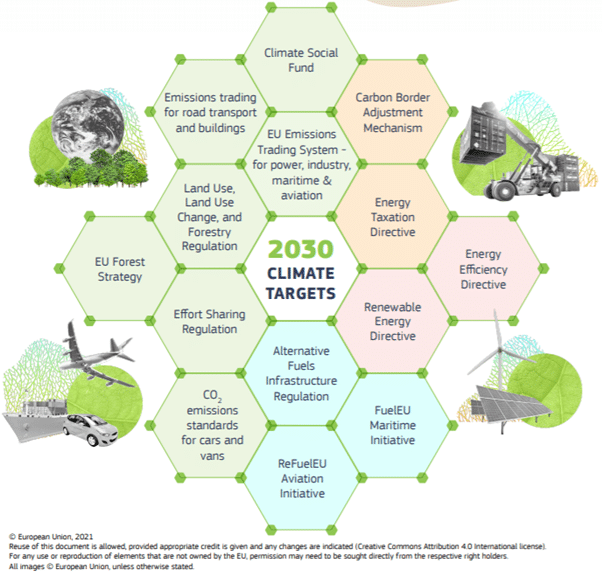
Climate change remains one of the most pressing global challenges, with 2024 recorded as the warmest year on record. The EU continues to implement climate policies aligned with its long-term goals, including achieving climate neutrality by 2050, reducing greenhouse gas emissions by 55% by 2030 compared to 1990 levels, and a proposed 90% reduction by 2040. To meet these climate targets, the EU has introduced stringent regulations that focus on emission monitoring, promoting cleaner energy use, and enhancing environmental protections. These regulations are shaping corporate strategies and compliance efforts across industries.
Hazardous Substances Management and Chemical Regulations
The EU continues to strengthen hazardous substances regulations, particularly regarding per- and polyfluoroalkyl substances, chemical classification, and fluorinated gases. New restrictions on PFHxA under the REACH regulation came into force in September 2024, affecting consumer goods such as textiles, food packaging, household chemicals, cosmetics, and certain firefighting foams. Transition periods range from 18 months to five years, depending on the availability of safer alternatives. A proposal to restrict over 10,000 PFAS substances is currently under review by the European Chemicals Agency, with further assessments expected in 2025.
The revised Classification, Labelling, and Packaging regulation, effective since December 2024, introduces harmonized classification rules, mandatory deadlines for updating chemical labels, and new conditions for online sales of hazardous substances. Digital labeling requirements and stricter hazard communication protocols will impact manufacturers and suppliers throughout the chemical industry.
The F-Gas Regulation, in force since March 2024, introduces additional requirements for manufacturers, suppliers, exporters, and users of fluorinated gases. From January 2025, updated labeling requirements will apply to F-Gas-containing products, with revised reporting formats becoming mandatory from March 2025. Companies involved in HVAC, refrigeration, and industrial applications will need to comply with stricter certification and reporting protocols.
Workforce Policies and Remote Work Regulations
The evolving regulatory landscape for worker protection includes new national policies on remote work and occupational safety. While the European Commission is evaluating potential harmonized regulations, individual member states have taken independent legislative action. Austria has introduced a new regulation, effective January 1, 2025, expanding occupational accident insurance coverage for remote workers, including those using co-working spaces. Employers must report workplace accidents occurring in such locations, including commutes to and from these spaces. Bulgaria enacted a right-to-disconnect law in 2024, ensuring that remote employees are not required to engage in work-related communication outside contractual hours. From September 2024, companies in Bulgaria may conduct occupational health and safety training entirely online.
Implications for Public Affairs and Compliance Managers
As the EU regulatory landscape evolves, Public Affairs and Compliance Managers play a crucial role in ensuring that businesses remain aligned with shifting legal frameworks. These legislative changes will influence corporate sustainability disclosures, supply chain accountability, emissions monitoring, chemical safety standards, and labor protections. The pace of national transpositions and potential regulatory refinements will require businesses to monitor legislative updates closely and engage with policymakers where necessary. The implementation of these regulations across EU member states will shape compliance expectations, affecting reporting requirements, environmental obligations, and corporate risk management strategies.