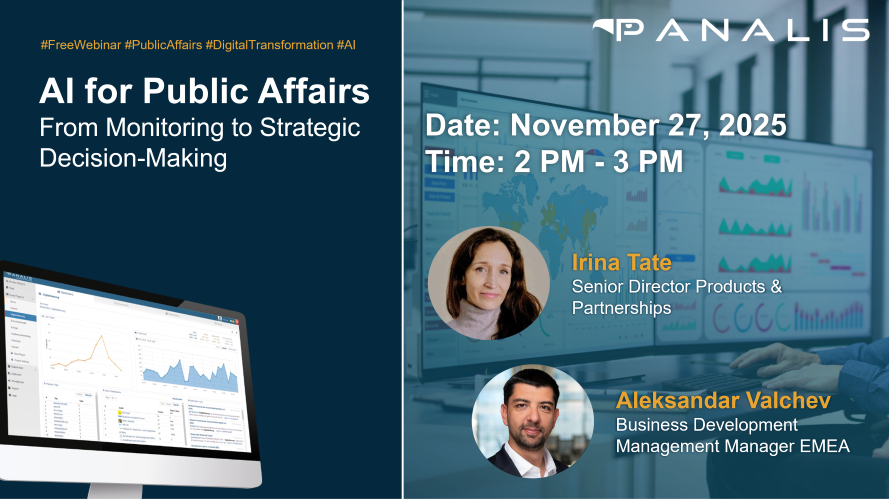
Event: AI for Public Affairs – From Monitoring to Strategic Decision-Making

In the final quarter of the year, many Public Affairs teams are reviewing how they monitor, analyze, and respond to fast-moving policy developments. With the new PANALIS Copilot, we’re showing how Artificial Intelligence is reshaping political intelligence – faster, smarter, and more precise than ever before.

PANALIS COPILOT – YOUR AI-POWERED ASSISTANT FOR PUBLIC AFFAIRS
Our interactive assistant combines multiple large language models, specifically trained for the political and regulatory landscape. It enables you to:
▪ Generate summaries, position and impact analyses in seconds
▪ Compare legislative texts and stakeholder positions effortlessly
▪ Receive actionable recommendations based on real context
▪ Identify potential impacts on your organization or industry instantly

The result: faster context understanding, optimized processes, and significant cost savings – giving your team more time to focus on strategic priorities.

WHY ORGANIZATIONS RELY ON PANALIS
PANALIS accelerates decision-making, improves risk control, and delivers measurable efficiency gains through:
▪ Comprehensive monitoring across 280,000+ EU and national sources
▪ Real-time alerts and automated reporting
▪ Secure, cloud-free, GDPR-compliant infrastructure hosted in Germany


MEET THE SPEAKERS

Irina Tate serves as Senior Director Products & Partnerships at PANALIS Solutions, where she leads strategic projects, key accounts, and partnership initiatives to support market expansion. With a strong foundation in European studies, international relations, and responsible AI, she combines expertise in innovation management, data ethics, and sustainable business transformation. Irina is dedicated to fostering impactful collaborations that bridge technology, ethics, and business strategy.

As Business Development Manager EMEA at PANALIS Solutions, Aleksandar Valchev drives client engagement and sales growth across Europe, with a particular focus on Brussels. With a background in European integration and international relations, he brings extensive experience in B2B sales development, CRM optimization, and digital outreach strategies. Aleksandar is passionate about aligning business initiatives with broader strategic goals and delivering exceptional customer experiences.


YOUR ADVANTAGE IN ATTENDING
Learn how AI-driven monitoring and analytics can transform your organization’s policy intelligence – from early-warning systems to automated briefings and strategic impact assessments.


The number of participants is limited. Secure your free spot now.


Thu, November 27, 2026 – 02:00 PM (CET)


}

02:00 PM – 03:00 PM (CET)

Webinar

AI for Public Affairs – From Monitoring to Strategic Decision-Making

Reserve your spot now and stay ahead in AI Topics!
  •  

Register now and secure your spot!

9 + 14 =

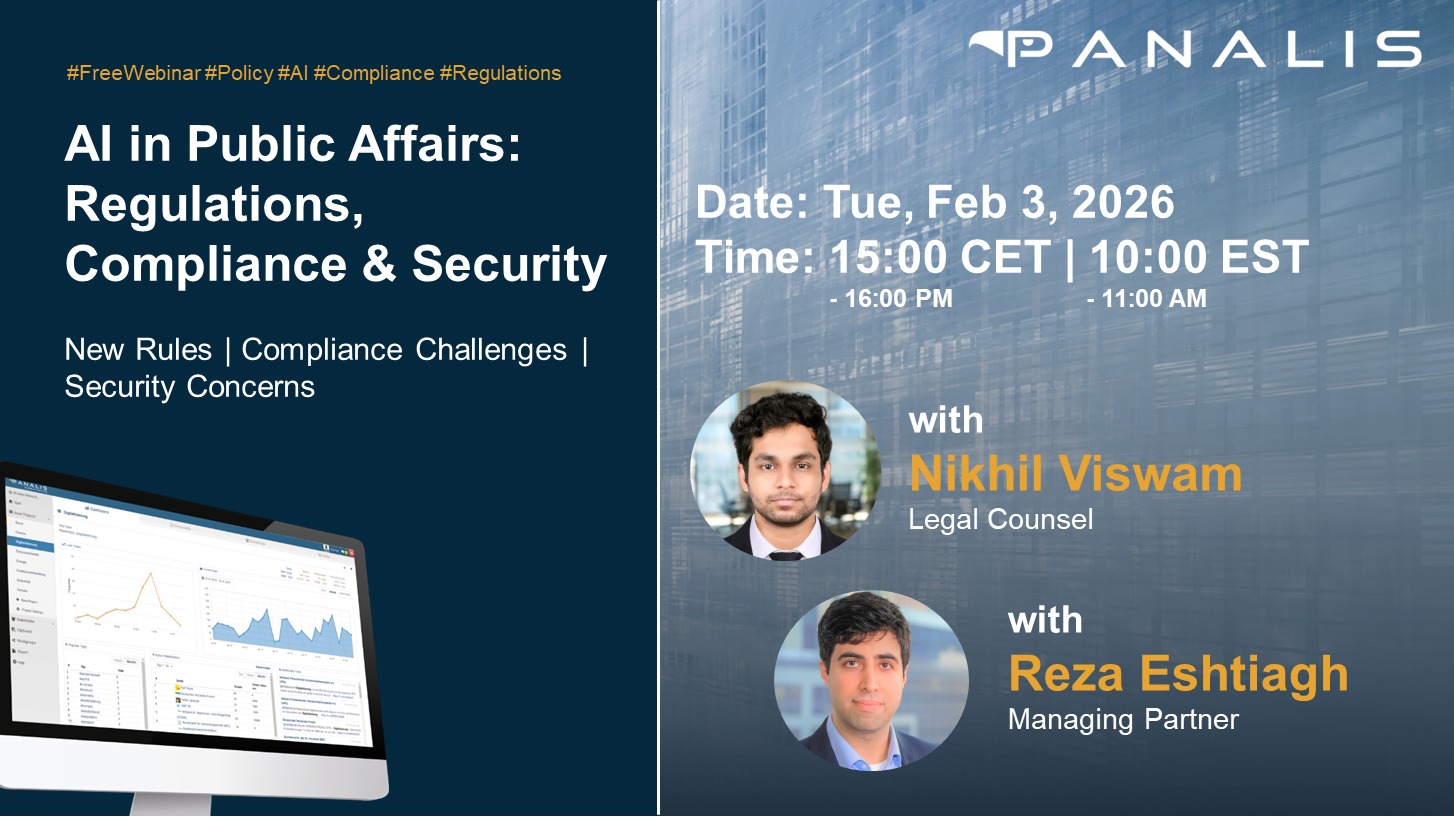
Event: AI in Public Affairs: Regulations, Compliance & Security

Artificial Intelligence is transforming Public Affairs – but with innovation come new regulations, compliance requirements, and security challenges.

Join us for an exclusive webinar hosted by our Legal Counsel, Nikhil Viswam, where we will discuss:
✅ The EU AI Act and U.S. frameworks (NIST, Executive Orders)
✅ Data protection and compliance (GDPR, CCPA)
✅ Security, transparency, and bias in AI-driven tools
✅ Best practices for agencies, corporates, and organizations


The number of participants is limited. Secure your free spot now.

Tue, February 3, 2026 – 10:00 AM (EST) | 15:00 (CET)

}

10:00 AM – 11:00 AM

Webinar

AI in Public Affairs: Regulations, Compliance & Security

Reserve your spot now and stay ahead in US policy monitoring!
  •  

Register now and secure your spot!

9 + 10 =

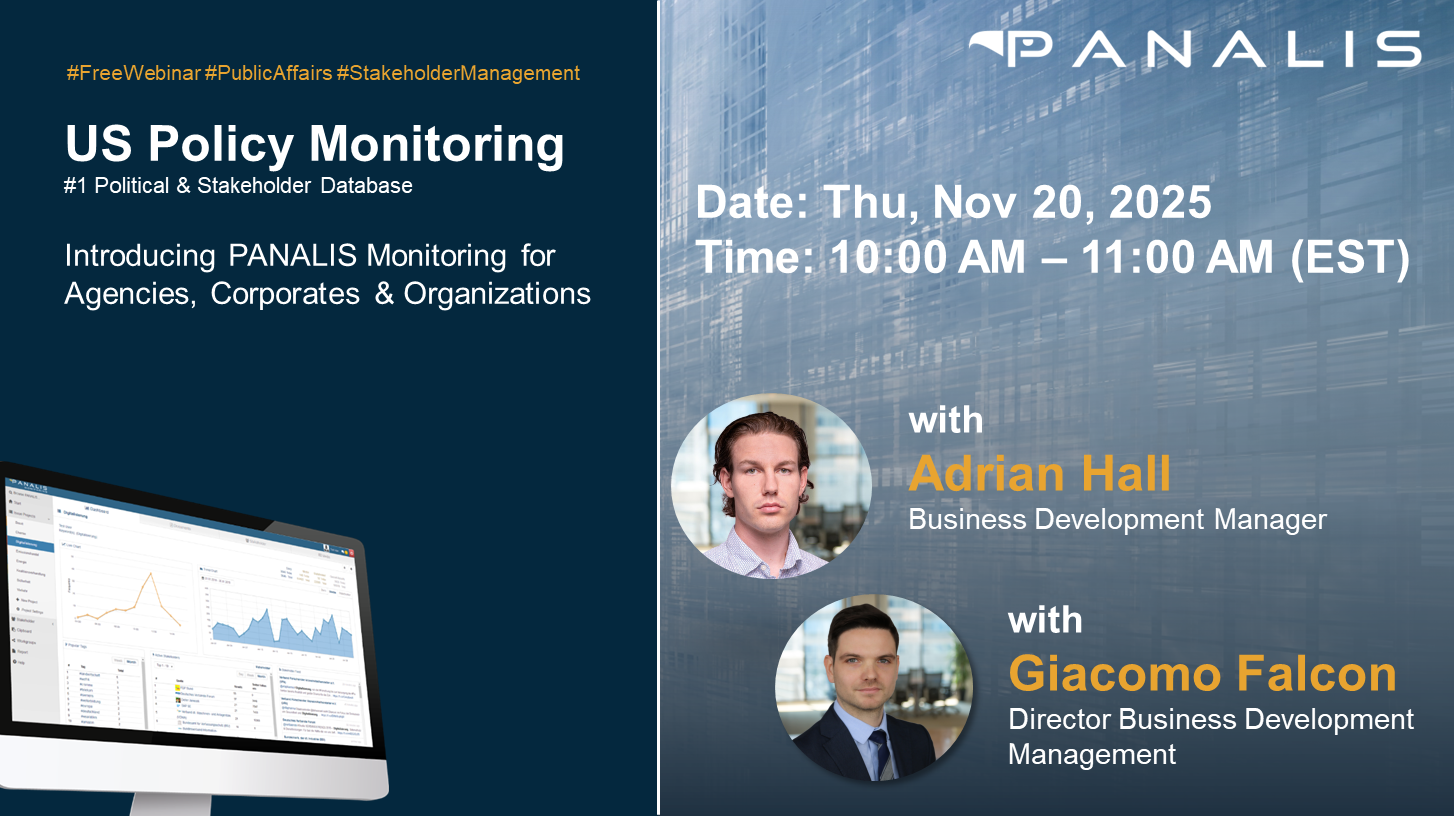
Event: US Policy Monitoring – Introducing PANALIS Monitoring

Discover how PANALIS Monitoring provides comprehensive coverage across the United States, including national-level insights, key large states, and thousands of stakeholders – from social media to press releases.

Join our webinar to see how agencies, corporations, and organizations can leverage PANALIS Monitoring to track political developments, stakeholder activity, and emerging trends in real time.

As a webinar participant, you can try PANALIS Monitoring for free and benefit from a special introductory price.


The number of participants is limited. Secure your free spot now.

Thu, November 20, 2025 – 10:00 AM (EST)

}

10:00 AM – 11:00 AM

Webinar

US Policy Monitoring – Introducing PANALIS Monitoring

Reserve your spot now and stay ahead in US policy monitoring!
  • As a webinar participant, you can try PANALIS Monitoring for free and benefit from a special introductory price.

Reserve your spot now!

11 + 8 =

Public Affairs Report 2025 – Strategies, Trends & Technologies

How can public affairs teams remain capable of taking action in an environment that changes daily? 

Political decisions today are made in real time. Legislative initiatives are accelerating, new regulations are introduced on a near-weekly basis, and in parallel, stakeholder networks are becoming more complex, societal expectations more demanding, and public discourse is shifting increasingly into digital spaces. 

For public affairs professionals, this means responding faster, prioritizing more precisely, and acting with greater strategic foresight. But how effectively is this being achieved in practice? Which digital tools are truly being used? And how is the very role and identity of political communication evolving amid increasing digitalization, information overload, and geopolitical uncertrainty? 

The Public Affairs Report 2025 seeks to answer these questions. It draws on an extensive survey of 192 professionals from companies, associations, and NGOs across Germany, Austria, Switzerland, France, Belgium, and the Netherlands. 

This report offers strategic orientation at a time of profound political transformation. We invite you to explore the realities of those who are shaping political communication today – and who must provide direction in the uncertainty of tomorrow. 

A First Glimpse: What the Public Affairs Report 2025 Reveals

How much potential does artificial intelligence hold for political communication?

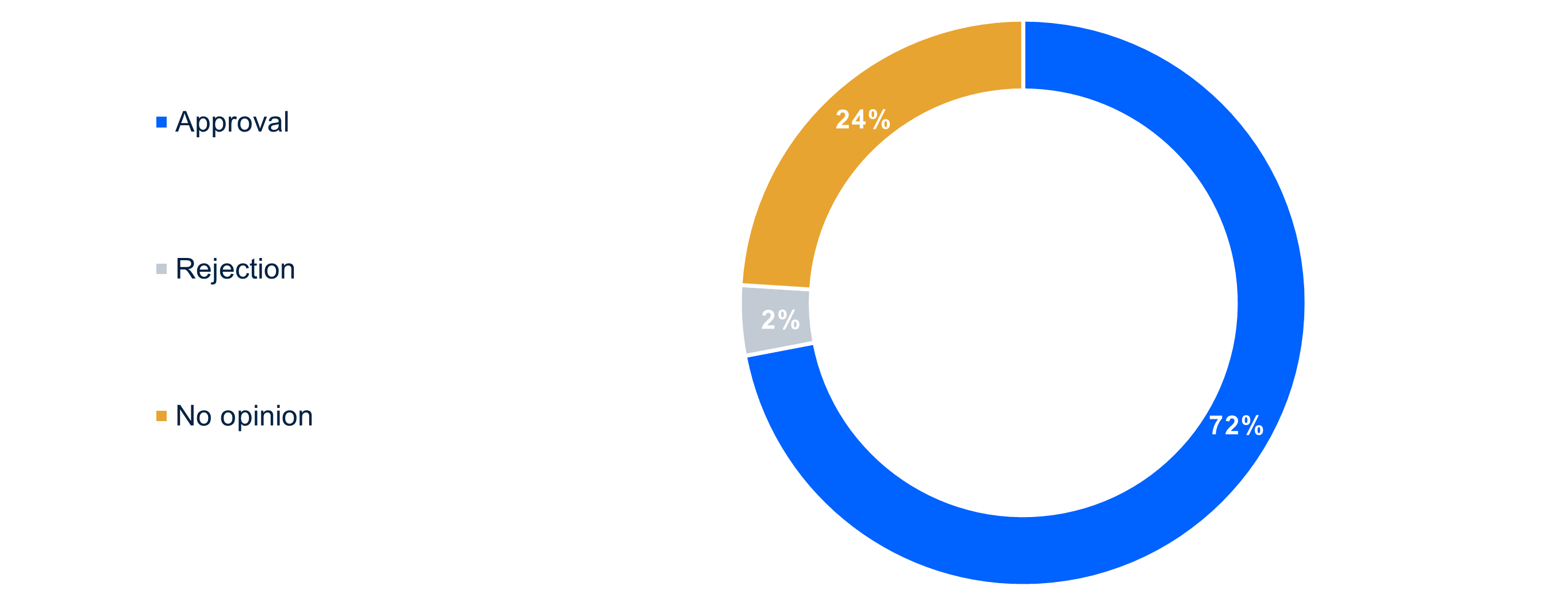
The latest findings on the use of artificial intelligence (AI) in information selection present a clear picture: around 72% of respondents support the use of AI technologies to help identify and prioritize relevant political information.

Whether it is filtering legislative texts, analyzing political narratives, or prioritizing complex topics – the potential of AI in public affairs is widely acknowledged.

And yet, despite this openness, only a fraction of respondents currently use such technologies in practice.

Why is there such a significant gap between intention and implementation? And what does this mean for the future of political communication?

We explore these and other key questions in the Public Affairs Report 2025 – designed for those who are ready to think strategically about what lies ahead.

Request now for free :

Public Affairs Report 2025

11 + 10 =

Key EU Regulatory Changes in 2025: Implications for Public Affairs and Compliance Managers

The European Union is introducing several key regulatory changes in 2025, impacting compliance strategies and policy engagement across multiple industries. Public Affairs and Compliance Managers must monitor these developments closely, as they will influence corporate reporting obligations, supply chain responsibilities, environmental compliance, and workforce policies. Understanding the implications of these regulations is essential for anticipating risks and ensuring organizational preparedness.

Corporate Sustainability Reporting and Due Diligence

The Corporate Sustainability Reporting Directive, adopted in 2023, requires large and publicly traded companies to disclose detailed reports on social and environmental risks affecting their operations. EU member states were required to transpose this directive into national law by July 6, 2024. However, as of early 2025, some member states have yet to complete this process, potentially leading to rapid legislative adjustments. Companies operating across multiple jurisdictions must remain alert to national variations in implementation and potential shifts in reporting requirements.

The Corporate Sustainability Due Diligence Directive, in force since July 2024, establishes legally binding due diligence obligations concerning human rights and environmental risks in corporate supply chains. The directive applies to companies exceeding certain revenue and employee thresholds, reinforcing obligations to assess, prevent, and mitigate negative impacts. While enforcement begins in 2027, legislative developments and national adaptations will shape compliance expectations in the coming years.The goal of the “Omnibus” package is to simplify the reporting requirements.


EU Nature Restoration Law and Environmental Compliance

The EU Nature Restoration Law, effective since August 2024, mandates ecosystem restoration efforts as part of the EU’s broader climate and biodiversity strategy. The regulation requires member states to restore at least 20 % of degraded land and marine areas by 2030, with full ecosystem restoration set as a goal for 2050. Member states must submit national restoration plans to the European Commission by September 1, 2026, detailing their strategies for meeting these targets. While the law primarily applies to governments, businesses operating in industries such as construction, agriculture, and energy may experience indirect regulatory impacts. National-level pollution control measures, stricter environmental assessments, and increased scrutiny of industrial land use practices are expected as part of implementation efforts.

Emissions Trading System and Climate Policy

The EU has intensified its efforts to reduce emissions by strengthening the Emissions Trading System. In September 2024, amendments to the Implementing Regulation (EU) 2018/2066 introduced stricter monitoring and reporting obligations for installations covered under the EU Emissions Trading System. These amendments require all operators of stationary installations to report emissions from activities directly linked to their operations, including those that influence emissions and pollution levels. Additionally, facilities must now monitor and report emissions from the carbon content of fuels such as biomass and synthetic low-carbon fuels, even when the emission factor is zero. These new requirements came into force on January 1, 2024, with annual reporting deadlines set for March 31. From 2025, airlines will also be required to monitor and report their use of alternative aviation fuels annually by March 31.

Climate change remains one of the most pressing global challenges, with 2024 recorded as the warmest year on record. The EU continues to implement climate policies aligned with its long-term goals, including achieving climate neutrality by 2050, reducing greenhouse gas emissions by 55% by 2030 compared to 1990 levels, and a proposed 90% reduction by 2040. To meet these climate targets, the EU has introduced stringent regulations that focus on emission monitoring, promoting cleaner energy use, and enhancing environmental protections. These regulations are shaping corporate strategies and compliance efforts across industries.

Hazardous Substances Management and Chemical Regulations

The EU continues to strengthen hazardous substances regulations, particularly regarding per- and polyfluoroalkyl substances, chemical classification, and fluorinated gases. New restrictions on PFHxA under the REACH regulation came into force in September 2024, affecting consumer goods such as textiles, food packaging, household chemicals, cosmetics, and certain firefighting foams. Transition periods range from 18 months to five years, depending on the availability of safer alternatives. A proposal to restrict over 10,000 PFAS substances is currently under review by the European Chemicals Agency, with further assessments expected in 2025.

The revised Classification, Labelling, and Packaging regulation, effective since December 2024, introduces harmonized classification rules, mandatory deadlines for updating chemical labels, and new conditions for online sales of hazardous substances. Digital labeling requirements and stricter hazard communication protocols will impact manufacturers and suppliers throughout the chemical industry.

The F-Gas Regulation, in force since March 2024, introduces additional requirements for manufacturers, suppliers, exporters, and users of fluorinated gases. From January 2025, updated labeling requirements will apply to F-Gas-containing products, with revised reporting formats becoming mandatory from March 2025. Companies involved in HVAC, refrigeration, and industrial applications will need to comply with stricter certification and reporting protocols.

Workforce Policies and Remote Work Regulations

The evolving regulatory landscape for worker protection includes new national policies on remote work and occupational safety. While the European Commission is evaluating potential harmonized regulations, individual member states have taken independent legislative action. Austria has introduced a new regulation, effective January 1, 2025, expanding occupational accident insurance coverage for remote workers, including those using co-working spaces. Employers must report workplace accidents occurring in such locations, including commutes to and from these spaces. Bulgaria enacted a right-to-disconnect law in 2024, ensuring that remote employees are not required to engage in work-related communication outside contractual hours. From September 2024, companies in Bulgaria may conduct occupational health and safety training entirely online.

Implications for Public Affairs and Compliance Managers

As the EU regulatory landscape evolves, Public Affairs and Compliance Managers play a crucial role in ensuring that businesses remain aligned with shifting legal frameworks. These legislative changes will influence corporate sustainability disclosures, supply chain accountability, emissions monitoring, chemical safety standards, and labor protections. The pace of national transpositions and potential regulatory refinements will require businesses to monitor legislative updates closely and engage with policymakers where necessary. The implementation of these regulations across EU member states will shape compliance expectations, affecting reporting requirements, environmental obligations, and corporate risk management strategies.

Request a demo
Learn about the advantages of PANALIS