
General Large Language Models (LLMs) are a technological breakthrough. Especially when it comes to quickly accessing broadly available knowledge. However, as soon as highly specialized and demanding use cases such as political analysis and legislative monitoring are involved, their fundamental limitations become clearly visible. Below, we would like to highlight several key challenges by way of example:
1. No organization-specific knowledge
Standard LLMs have no understanding of your organization. They are unfamiliar with your stakeholder structures, internal positions, strategic priorities, or ongoing political dossiers. As a result, their answers inevitably remain generic—regardless of how specific the question may actually be.
2. Lack of up-to-date information
Political processes are dynamic and in some cases change daily. Traditional LLMs, however, are based on training data with a time lag and have no native access to current legislative developments. This means that decision-relevant information may be missing or outdated.
3. Risk of hallucinations
LLMs generate responses based on statistical probabilities, not on verified facts. This can be particularly problematic in a political context: content may sound plausible without actually being correct—a risk for analysis, reporting, and strategic decision-making.
4. High dependence on precise prompting
The quality of results depends heavily on the input. Even minor inaccuracies in wording can lead to significantly different or unusable responses. In day-to-day operations, this level of prompt engineering is neither realistic nor reliably scalable.
5. No integration into existing workflows
LLMs are generally isolated tools with no connection to internal company data, workflows, or monitoring systems. This creates process disruptions that make direct use in everyday work more difficult and leave efficiency potential untapped.
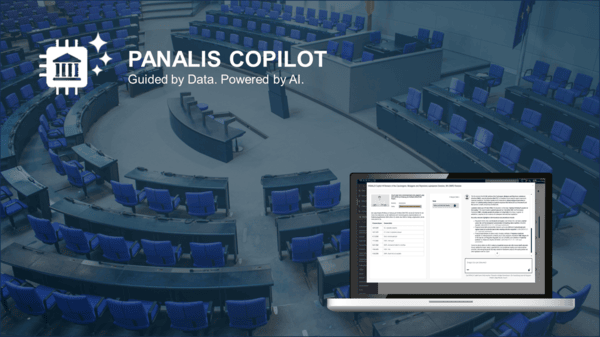
The PANALIS Copilot was developed specifically for Public Affairs, with a clear focus on relevance, timeliness, and integration. While traditional LLMs rely on general knowledge, the PANALIS Copilot combines curated expert data with organization-specific knowledge and current monitoring data. The result is not generic answers, but well-founded, context-based assessments that can be used directly in day-to-day work.
A key difference lies in the technological approach: through the use of Retrieval-Augmented Generation (RAG), the PANALIS Copilot accesses current documents, dossiers, and reliable sources, linking them with internal information. This makes the results not only more up to date, but also transparently derived. Hallucinations, which can occur with conventional LLMs, are significantly reduced.
Its working model also delivers clear added value. While publicly available LLMs depend heavily on prompts and provide isolated answers, the PANALIS Copilot reflects real Public Affairs processes. Built-in rules, integrated logic, and the continuous use of current monitoring data mean that less prompt engineering is required, while concrete and productive outcomes are achieved instead.
Another decisive factor is data security. Especially in the Public Affairs environment, handling sensitive information is critical. The PANALIS Copilot ensures full data sovereignty within your own system—with servers located in Germany—and also offers options for anonymization or the complete deactivation of LLM queries. This prevents any uncontrolled transfer of data.
Request a trial:
PANALIS Copilot